


You're leaving the house with a full bottle, one hand already busy with keys or a phone, and the rest of the morning doesn't slow down for that. On a packed train, in a stroller park, at a terminal gate, or on a trail with uneven footing, an insulated water bottle with strap changes one thing right away, it gives you a way to carry hydration without fully occupying your hand.
That sounds small until you're trying to board, scan, push, lift, or balance at the same time. The strap isn't just a style add-on, it changes how the bottle fits into a real routine, and that makes the buying decision more practical than people expect.
Table of Contents
- Why a Strapped Insulated Bottle Matters in Daily Life
- How Insulated Bottles and Straps Actually Work
- Common Strap Styles and What Each One Does Best
- Attachment Methods That Affect Comfort and Security
- Where a Strapped Bottle Shines and Where It Falls Short
- Durability, Cleaning, and Long-Term Ownership
- Choosing the Right Strapped Bottle for Your Routine
Why a Strapped Insulated Bottle Matters in Daily Life
A strap starts to matter the moment your day stops being a straight walk from desk to desk. A commuter with a laptop bag, a parent steering a stroller, a traveler rolling a carry-on, and a hiker stepping over roots all have the same problem, one hand is rarely free when they want a sip.
That's where the strap changes the bottle from something you hold to something you hang, sling, or hook. Instead of gripping a stainless cylinder every time you move, you can let it ride on your wrist, shoulder, bag, or finger for the short stretches when your hands are already spoken for.
The real gain is not fashion, it's fewer interruptions
A strapped bottle can make transitions smoother. You can keep a pass in one hand and your drink in the other, clip a bottle to a daypack, or carry it through a terminal without stopping to rearrange your grip every few minutes.
Practical rule: if your bottle is only out for a sip and then goes back into a bag, the strap matters less. If you keep needing both hands in motion, the strap earns its keep.
The category also makes sense because insulated bottles themselves are no longer a tiny niche. One market report estimates the insulated water bottle market at USD 2.27 billion in 2024 and projects USD 3.31 billion by 2035, while another puts the category at USD 4.97 billion in 2025 and forecasts USD 8.99 billion by 2035 (Kaiso Research). That growth matters because the strap is usually an accessory layered onto an already strong portability category.

The useful question isn't “is a strap cool?” It's “does my day make one hand scarce enough that the strap reduces friction?” That's the lens for the rest of this guide, insulation, strap construction, and the trade-offs that show up after the first week of use.
How Insulated Bottles and Straps Actually Work
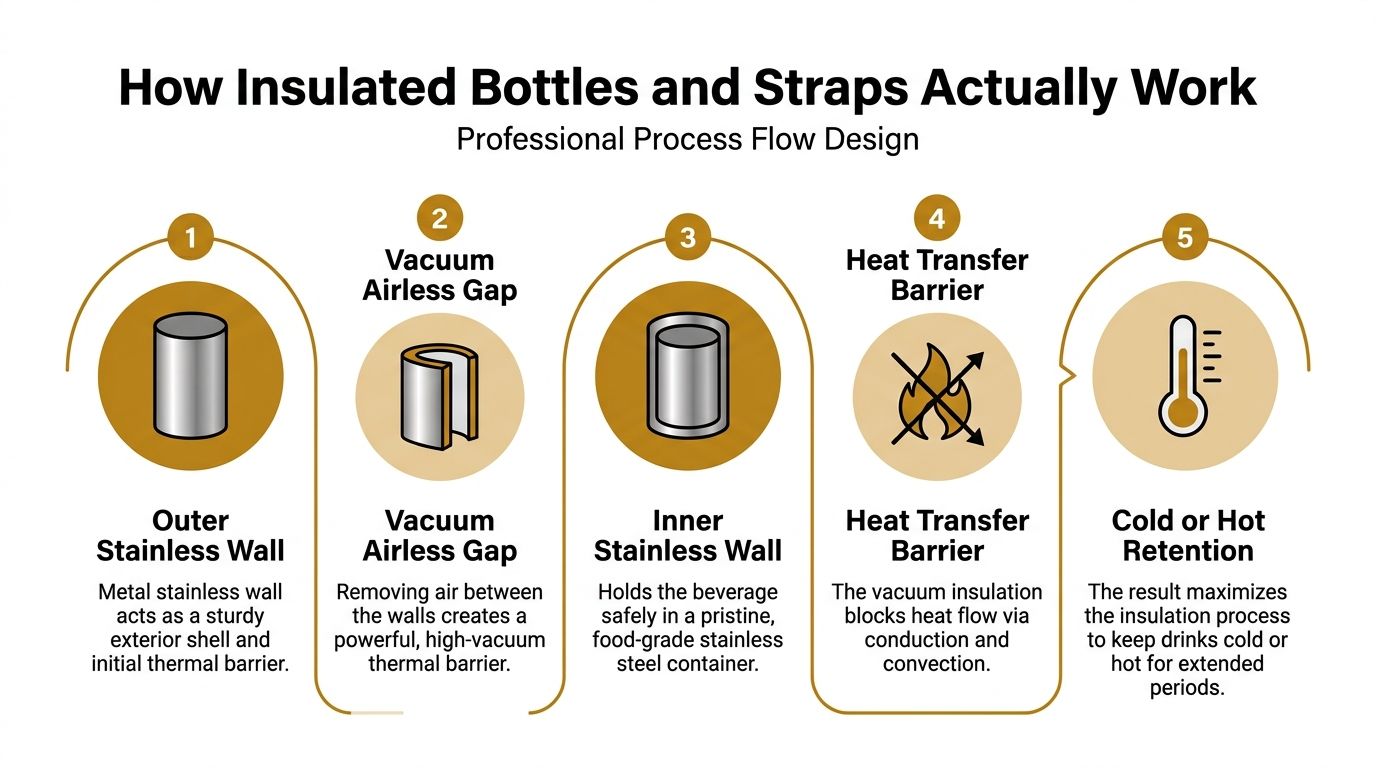
An insulated bottle keeps temperature under control because of double-wall vacuum insulation. Two stainless walls are separated by an airless gap, and that gap slows heat transfer so much that cold drinks stay cold and hot drinks stay hot far longer than a single-wall container.
Stanley's product guidance says high-quality vacuum-insulated stainless-steel bottles can keep drinks cold for up to 24 hours, hot for at least 20 hours, and ice for up to 4 days (Stanley 1913). Those numbers are useful as a ceiling for what well-made bottles can do in ideal conditions, not as a promise every lid and every commute will match exactly.
What the strap does and doesn't do
The strap is a separate system. It doesn't improve insulation, it doesn't hold temperature, and it doesn't make a mediocre bottle perform better. What it does is carry weight, so the strap has to be built like a load-bearing part, not a decorative loop.
Good straps use woven nylon webbing, reinforced stitching, and hardware that won't loosen under motion. Cheap loops often look fine on day one, then fray, twist, or fail once the bottle starts swinging against a bag or body.
A strap can also change how the bottle feels in use. If the anchor point sits too close to the lid, your hand can end up touching the coldest or hottest area near the top. If it sits lower, the bottle may swing more, which is fine on a short walk and annoying on a bike or crowded platform.
A dangling strap adds convenience only when it stays out of the way. If it swings into your leg, bag, or stroller frame, it stops being helpful fast.
For the insulation side, the important point is simple, vacuum construction beats air-gap shortcuts. For the strap side, the important point is equally simple, attachment strength matters more than visual style. That's why buyers should look at the bottle and the carry system as two different pieces of engineering that happen to share the same product.
To see the core bottle mechanics in a plain-language format, Velvet Muse's overview of how insulated bottles work is a helpful companion read: how insulated water bottles work.
Common Strap Styles and What Each One Does Best
The strap styles buyers see most often solve different carry problems, which is why “best” depends so much on routine. A strap that feels perfect on a quick walk can be awkward on a full commute, and a strap that looks minimal can be the wrong choice if you're constantly switching hands.
Four common styles
| Strap Style | Best For | Key Trade-off |
|---|---|---|
| Fixed fabric loop | Short walks, bag carry, minimal bulk | No adjustability |
| Adjustable webbing strap | Commuting, cross-body use, mixed carry | More hardware, more snag risk |
| Detachable clip or carabiner strap | Travel, gym bags, clipping to packs | Can swing unexpectedly |
| Paracord or woven handle | Short hand carries, quick lifts | Less comfortable when full |
Fixed loops stay simple because there's less to adjust, fewer parts to fail, and less bulk to catch on other items. They're a good fit if the bottle mostly lives in a backpack pocket or gets moved by hand in short bursts.
Adjustable webbing straps are the most flexible choice. They let you shift between shoulder carry, cross-body wear, and short hand carry, which helps if your day alternates between walking, transit, and bag storage.
Detachable clips and carabiner-style straps are useful when you want the bottle to hang from a pack or tote. They're convenient for travel or the gym, but that freedom can also make the bottle swing more than you want during fast movement.
Paracord and woven handles are best for quick lifts, not long wear. They feel decent when the bottle is only partly full or carried for a short stretch, but a heavy insulated bottle can make a thin handle dig into your hand.
The easiest way to choose
Match the strap to the motion, not the bottle photo. If you're mostly hanging the bottle, pick a clip or loop. If you're carrying it across a long walk, pick adjustability. If you're just moving it from car to desk, a handle is enough.
A lot of confusion comes from assuming all straps are doing the same job. They aren't. Some are for control, some for flexibility, and some are just there to make a short carry less annoying.
Attachment Methods That Affect Comfort and Security
Where the strap connects matters as much as what the strap is made from. A high anchor point, a side mount, or a cap-integrated loop each changes how the bottle hangs, how it swings, and how secure it feels when you're moving through a crowd.
What the anchor point changes
A top-loop attachment keeps the bottle close to your hand and usually feels balanced for short carries. It's compact, but if the loop loosens over time, the bottle can start to feel less stable.
A side-mounted strap moves the pull point off center. That can be comfortable when you want the bottle to hang lower, but it also increases swing, which is why it can bump a leg or bag edge during active movement.
A dual-lug system spreads load across two points. That usually feels steadier because the bottle resists twisting, which is useful when the bottle is full and moving around a lot.
A cap-integrated anchor keeps the design neat, but the cap is where stress, wear, and leaks become more sensitive, especially if the hardware is doing double duty as both closure and carry point.
Hardware and load distribution
Swivel hooks and carabiners make a strap easier to move, but they can add noise and extra motion. Bolt snaps are quick to clip and unclip, while sewn-on loops are often the simplest and quietest option.
Wide webbing spreads pressure better than narrow cord, which matters when the bottle is heavy. Metal hardware can also add weight to the lid, so a design that looks compact may feel top-heavy once it's full.
The stress point to watch is the mount itself. Plastic lugs can crack over time if they're asked to carry a full bottle repeatedly, especially if the bottle gets dropped or yanked sideways.
For a crowded train ride, the safest-feeling setup is usually the one that keeps the bottle close to your body and reduces swing. For pavement drops or active use, the more secure setup is the one with the strongest anchor points and the fewest weak seams.
Where a Strapped Bottle Shines and Where It Falls Short
A strap helps most when your hands are already busy. That simple fact explains why the category feels so useful in some routines and so fussy in others.
Commuting and travel
On a commute, a short loop or clip can free up a hand while you scan a pass, hold a rail, or keep a bag from slipping. The benefit fades if the strap is too long, because a bottle that swings into other people or catches on a seat adds one more task to manage.
Travel works the same way. A detachable clip makes it easy to hang a bottle from a daypack or tote between stops, but it does not change the situation of airport security, where the bottle still comes out of the bag. The strap helps with carrying, not with screening.
Gym, outdoor use, and parenting
At the gym or on a trail, a strap can matter because your hands may already be tied up with weights, poles, or a stroller. A bottle that hangs from a pack or stays looped to your wrist is easier to keep track of than one you have to grip every few minutes.
There is a trade-off, though. Soft fabric can hold sweat, dirt, and odor, so the strap needs its own cleaning attention. A plain stainless bottle often asks for less of that care.
A parent pushing a stroller may like the speed of grabbing a strapped bottle from a side pocket, then dislike the way the strap snags on a buckle or frame. That is the central trade-off of the category. Faster access comes with more snag points.
| Scenario | Best Strap Style | Convenience | Main Downside |
|---|---|---|---|
| Commute | Fixed loop or short adjustable strap | Keeps one hand free | Long straps swing on crowded transit |
| Travel | Detachable clip | Easy to hang from a bag | Still has to come out for security |
| Gym or outdoors | Adjustable webbing | Good when hands are already busy | Sweat and dirt build up on fabric |
| Parenting and errands | Short loop | Fast to grab and rehang | Can catch on stroller parts |
For longer trips where hydration fits into a bigger cold-storage setup, a dual-zone fridge like the ICECO APL55 can support the rest of the loadout while the bottle handles the day-to-day carry.
If you are choosing between a strapped bottle and a plain insulated bottle with a separate carrier, use one test. Will the strap solve a real carry problem, or will it just add another thing to clean and untangle? For some routines, the plain bottle is still the smarter buy.
For buyers comparing carry-focused products alongside hydration gear, Velvet Muse's product page for a compact insulated bottle option is a useful reference point: COLDEST 24oz Limitless Ultra v8.
Durability, Cleaning, and Long-Term Ownership
The part many underestimate is maintenance. A strap-equipped bottle can feel great on day one and become annoying later if the webbing stays damp, the hardware loosens, or the mount starts to show wear.
What wears out first
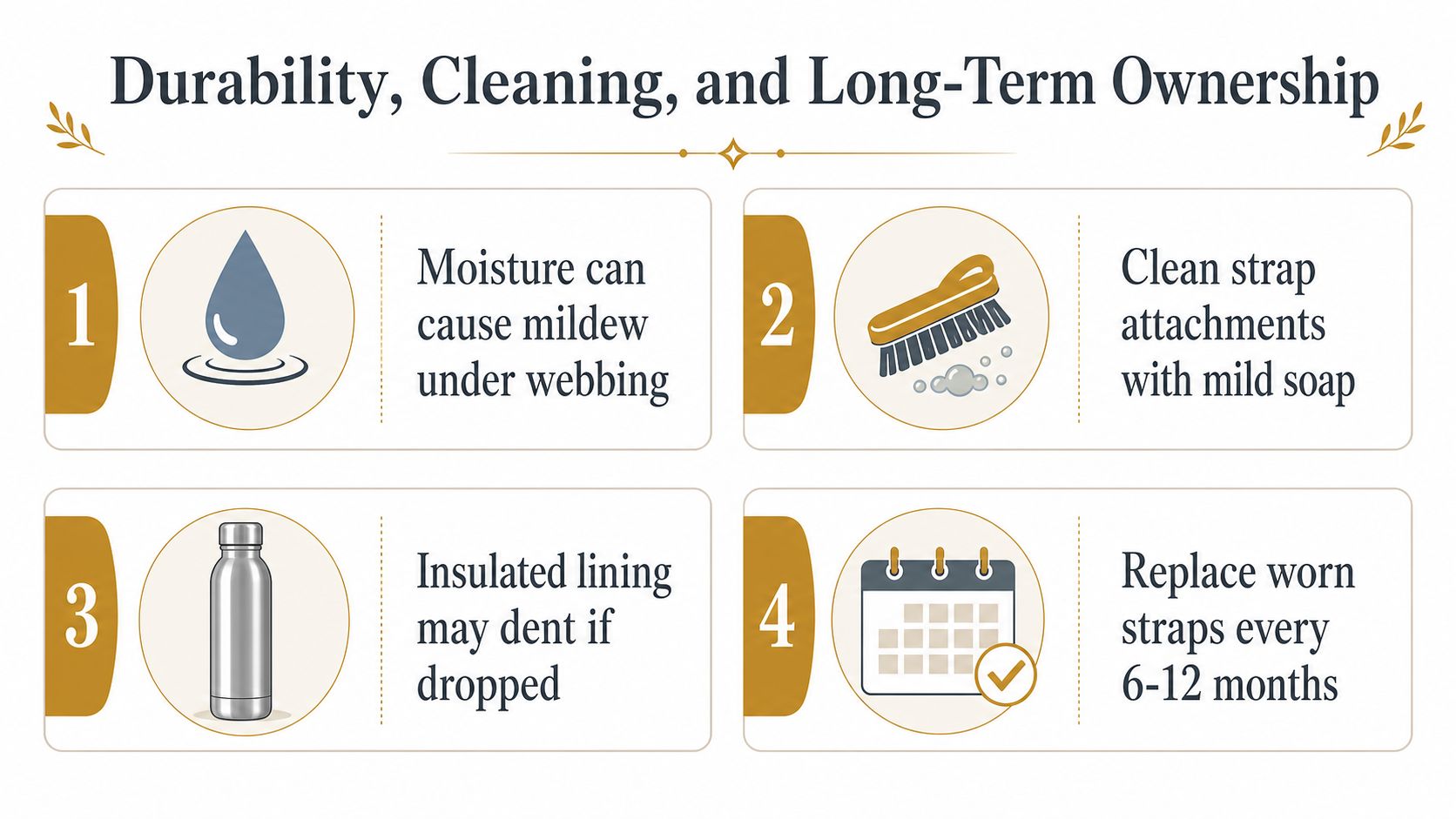
Fabric webbing can hold moisture against a cap or loop, which is why a bottle shouldn't go back into storage sealed and still damp. Product manuals for insulated bottles also emphasize disassembling straws and seals for cleanup, drying fully before storage, and avoiding dishwashers that can damage insulation or coatings (manufacturer care guidance).
That care burden matters more on a strapped bottle because there are more places for residue and moisture to hide. If the strap touches the lid, if the loop sits against a gasket, or if the hardware traps water after washing, the cleanup routine becomes longer.
Materials behave differently
Stitched polyester is usually easy to wipe down and tends to feel familiar in the hand. Woven nylon often feels stronger and more abrasion-resistant, while silicone is easy to rinse but can feel less structured.
Paracord can dry quickly, but it doesn't always feel as comfortable under load. Metal hardware is sturdy, yet it may corrode if it's constantly wet, and loose rivets can eventually make sewn loops wobble.
Simple maintenance rule: rinse straps separately when you can, stand the hardware upright to dry, and replace worn webbing instead of waiting for the whole system to fail.
Bigger straps aren't automatically better. They can trap more moisture, add more bulk, and make the bottle harder to stash after cleaning. The best ownership experience usually comes from a strap that's easy to dry, easy to inspect, and easy to replace.
A sensible habit changes the lifespan more than a flashy design does. Dry the bottle fully, check the anchor points before each trip, and treat the strap as a part that may need replacement while the bottle body keeps going.
Choosing the Right Strapped Bottle for Your Routine
Start with the routine, not the bottle size on the shelf. A larger bottle means more weight for the strap to carry, more stress at the attachment points, and more chance that a carry feature feels useful one day and tiring the next.
Quick buyer checklist
- Match the carry mode: choose a fixed loop for short walks, a clip for bag carry, or adjustable webbing if you switch between shoulder, cross-body, and hand carry.
- Check the longest stretch between fills: make sure the insulation is good enough for the part of the day when you can't refill easily.
- Test the lid while the bottle hangs vertically: a good seal should still feel secure when gravity is pulling on the bottle, not just when it sits on a table.
- Feel the strap under load: if it digs into your hand or twists awkwardly when full, that design will bother you more over time.
- Look for replaceable parts: stainless steel bodies, serviceable lids, and replaceable straps usually age better than sealed one-piece designs.
The right bottle also needs to fit your cleaning habits. If you know you won't dry parts thoroughly, choose a simpler strap system with fewer hidden seams and less hardware. If you want the bottle to live in a bag most of the day, prioritize compact attachments and a leakproof lid first.
A strap only feels like an upgrade when the total package stays manageable. If the bottle is too heavy to carry comfortably once it's full, the carry feature is solving the wrong problem.
For shoppers who want a bottle that keeps the focus on practical everyday carry, Velvet Muse curates hydration and lifestyle essentials with the same balance of design and utility this guide is built around. If you're comparing strapped bottles, plain insulated bottles, and other carry-friendly everyday gear, it's a good place to start with options that are meant to fit real routines, not just look good in a cart.
Drafted with Outrank tool


